THE LEGENDS,
LORE & LIES OF THE MYRTLES PLANTATION
THE LEGENDARY MYRTLES PLANTATION IN ST.
FRANCISVILLE, LOUISIANA HAS LONG BEEN REGARDED AS ONE OF “AMERICA’S MOST
HAUNTED HOUSES”. AND WHILE SCORES OF GHOST HUNTERS WILL SWEAR TO THE FACT THAT
THE HOUSE IS INFESTED WITH GHOSTS, THESE SAME INVESTIGATORS WOULD BE PUZZLED TO
LEARN THAT FEW OF THE STORIES THAT HAVE BEEN PASSED ALONG AS “FACT” ACTUALLY
OCCURRED THIS HOUSE IS CERTAINLY HAUNTED -- BUT NOT FOR ANY OF THE REASONS
THAT WE HAVE BEEN TOLD FOR SO LONG! FOR THE FIRST TIME, DISCOVER THE REAL STORY
BEHIND THE MYRTLES AND ITS PLETHORA OF GHOSTS AND HAUNTINGS! Handprints in the mirrors, footsteps on
the stairs, mysterious smells, vanishing objects, death by poison, hangings,
murder and gunfire -- the Myrtles Plantation in the West Feliciana town of St.
Francisville, Louisiana holds the rather dubious record of hosting more ghostly
phenomena than just about any other house in the country. But what could be
more dubious than the honor itself -- perhaps some of the questionable history
that has been presented to “explain” why the house is so haunted in the first place!
Long perceived as one of the most haunted house in America, the Myrtles attracts an
almost endless stream of visitors each year and many of them come in search of
ghosts. It is not our purpose here to do anything to discourage these visitors
from coming -- or even to discourage them to looking for the ghosts that they
can almost certainly find here. The purpose of this article is to question the
“facts” as they have been presented by several generations of Myrtles owners
and guides -- facts and history that many of them know is blatantly false. We
have no wish to try and debunk the ghosts, merely the identities that they have
been given over the years. The Myrtles, according to hundreds of people who
have encountered the unexplained here, is haunted -- but not for the reasons
that we have all been told.
But why go to the trouble to debunk the myths that have been created over the
last fifty-some-odd years? Surely, they aren’t hurting anyone, so why bother to
expose them as the creation of rich imaginations? To that, we can only say that
no dedicated ghost hunter should be afraid to seek the truth. As the history of
a house is the most important key to discovering just why it might be haunted
in the first place, it seems to be imperative to discover the real history of
the site. It has often been recommended to sift through the legends and
folklore of the place in a search for a kernel of truth. This is exactly what
we did in the article that follows --- we have examined the lore in a search
for the truth and have found it. It might not be as glamorous as the legends of
the Myrtles Plantation
that we have all heard about but it is certainly strange. The real history of
the plantation is filled with death, tragedy and despair, leading us to wonder
why a fanciful history was created in its place. That question will likely
never be answered but many others will.
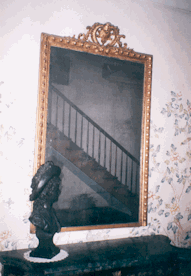 | 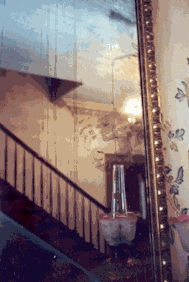 |
The house mirror where the spectral images of the
Myrtles’ “murder victims” are said to manifest. The closer look on the right
shows some of the marks believed to be signs from the spirits
THE HISTORY OF
THE MYRTLES PLANTATION: Since the Myrtles was built
by David Bradford in 1794, it has allegedly been the site of the scene of at
least 10 murders. In truth, only one person was ever murdered here but as has
been stated already, some of the people who have owned the house have never let
the truth stand in the way of a good story. But as you will soon see, the
plantation has an unusual history that genuinely did occur -- and one that
could (and has) left its own real ghosts behind.
THE TRUTH & THE LEGENDS
David Bradford was born in America
to Irish immigrants and was one of five children. In 1777. He purchased a tract
of land and a small stone house near Washington
County,
As his family and business grew, Bradford needed a larger home and built a new
one in the town of Washington.
The house became well known in the region for its size and remarkable
craftsmanship, with a mahogany staircase and woodwork imported from England. Many
of the items had to be transported from the east coast and over the
Unfortunately, he was not able to enjoy the house for long. In October 1794, he
was forced to flee the house, leaving his family behind. Bradford
became involved in the infamous Whiskey Rebellion and legend has it that
President George Washington placed a price on the man’s head for his role in
the affair. The Whiskey Rebellion took place in western
After leaving
After receiving the pardon, Bradford returned to
While living in Bayou Sarah, Bradford
occasionally took in students who wanted to study the law. One of them, Clark
Woodrooff, not only earned a law degree but he also married his teacher's
daughter, Sarah Mathilda.
Clark Woodrooff was born in Litchfield
County,
Still seeking to make his fortune, Woodrooff placed an advertisement in the new
St. Francisville newspaper, the Time Piece , in the summer of 1811. He informed
the public that "an academy would be opening on the first Monday in
September for the reception of students." He planned to offer English,
grammar, astronomy, geography, elocution, composition, penmanship and Greek and
Latin languages. The academy was apparently short-lived for in 1814, he joined
Colonel Hide's cavalry regiment from the Feliciana parish to fight alongside
Andrew Jackson at the Battle of New Orleans. When the smoke cleared and the War
of 1812 had ended, Woodrooff returned to St. Francisville with the intention of
studying law.
He began his studies with Judge David Bradford and soon earned his degree. He
also succumbed to the charms of the Bradford
daughter, the lovely Sarah Mathilda. Their romance blossomed under the shade of
the crape myrtles that reportedly gave the home its lasting name. The young
couple was married on November 19, 1817 and for their honeymoon, Woodrooff took
his new bride to the Hermitage, the
After the death of David Bradford, Woodrooff managed Laurel Grove for his
mother-in-law, Elizabeth. He expanded the holdings of the plantation and
planted about 650 acres of indigo and cotton. Together, he and Sarah Mathilda
had three children, Cornelia Gale, James, and Mary Octavia. Tragically though,
their happiness would not last.
On July 21, 1823, Sarah Mathilda died after contacting yellow fever. The
disease was spread through a number of epidemics that swept through
Woodrooff's life would never be the same but he managed to purchase the farm
outright from his mother-in-law. She was quite elderly by this time and was
happy to see the place in good hands. She continued to live at Laurel Grove
with her son-in-law and granddaughter Octavia until her death in 1830.
After Elizabeth
died, Woodrooff turned his attentions away from farming to the practice of law.
He and Octavia moved away from Laurel Grove and he left the plantation under
the management of a caretaker. He was appointed to a judge's position over
District D in Covington,
By this time, Woodrooff was living on
In 1840, the
An interesting side note to the story concerns this cemetery. The graveyard
fell into great disrepair and was eventually abandoned. In the 1960's, the city
hoped to renovate this part of the city and sent out a notice to families that
the cemetery was going to be moved to a new location on
In 1834, Laurel Grove was purchased by Ruffin Grey Stirling. The Stirling's
were a very wealthy family who owned several plantations on both sides of the Mississippi River. On January 1, Ruffin Grey Stirling and
his wife, Mary Catherine Cobb, took over the house, land, buildings and all of
the slaves that had been bought from Elizabeth Bradford by her son-in-law.
Since the Stirling's were so well thought of
in the community, they needed a house that was befitting their social status.
They decided to remodel Laurel Grove. Stirling
added the broad central hallway of the house and the entire southern section.
The walls of the original house were removed and repositioned to create four
large rooms that were used as identical ladies and gentlemen's parlors, a
formal dining room and a game room. Year-long trips to Europe
to purchase fine furnishings resulted in the importation of skilled craftsmen
as well. Elaborate plaster cornices were created for many of the rooms, made
from a mixture of clay, Spanish moss and cattle hair. On the outside of the
house, Stirling added a 107-foot long front
gallery that was supported by cast-iron support posts and railings. The
original roof of the house was extended to encompass the new addition, copying
the existing dormers to maintain a smooth line. The addition had higher
ceilings than the original house so the second story floor was raised one foot.
The completed project nearby doubled the size of David Bradford's house and in
keeping with the renovations, the name of the plantation was officially changed
to the "Myrtles".
Four years after the completion of the project, Stirling
died on July 17, 1854 of consumption. He left his vast holdings in the care of
his wife, Mary Cobb, who most referred to as a remarkable woman. Many other
plantation owners stated that she "had the business acumen of a man",
which was high praise for a woman in those days, and she managed to run all of
she and her husband's farms almost single-handedly, for many years.
In spite of this, the family was often visited by tragedy. Of nine children,
only four of them lived to be old enough to marry. The oldest son, Lewis, died
in the same year as his father and daughter Sarah Mulford's husband was
actually murdered on the front porch of the house after the Civil War. The war
itself wreaked on the Myrtles and the Stirling
family. Many of the family's personal belongings were looted and destroyed by
Federal soldiers and the wealth that they had accumulated was ultimately in
worthless Confederate currency. To make matters worse, Mary Cobb had been
invested heavily in sugar plantations that had been ravaged by the war. She
eventually lost all of her property. She never let the tragedies of the war,
and others that followed after, overcome her however and she held onto the
Myrtles until her death in August 1880. She is buried next to her husband in a
family plot at Grace Church in St. Francisville.
On December 5, 1865, Mary Cobb hired, William Drew Winter, the husband of her
daughter, Sarah Mulford, to act as her agent and attorney and to help her
manage the plantation lands. As part of the deal, she gave Sarah and William
the Myrtles as their home.
William Winter had been born to Captain Samuel Winter and Sarah Bowman on
October 28, 1820 in Bath,
Twelve years after the death of Ruffin Stirling, and after the Civil War,
William was named as agent and attorney by Mary Stirling to help her with the
remaining lands, including Ingleside, Crescent
Park, Botany Bay
and the Myrtles. In return, Mary gave William the use of the Myrtles as his
home. Times were terrible though and Winter was unable to hold onto it. By
December 1867, he was completely bankrupt and the Myrtles was sold by the U.S.
Marshal to the New York Warehouse & Security Company on April 15, 1868. Two
years late however, on April 23,the property was sold back Mrs. Sarah M. Winter
as the heir of her late father, Ruffin G. Stirling. It is unknown just what
occurred to cause this reversal of fortune but it seemed as though things were
improving for the family once again.
But soon after, tragedy struck the Myrtles once more. According to the January
1871 issue of the Point Coupee Democrat newspaper, Winter was teaching a Sunday
School lesson in the gentlemen's parlor of the house when he heard someone
approach the house on horseback. After the stranger called out to him and told
him that he had some business with him, Winter went out onto the side gallery
of the house and was shot. He collapsed onto the porch and died. Those inside
of the house, stunned by the sound of gunfire and the retreating horse, hurried
outside to find the fallen man. Winter died on January 26, 1871 and was buried
the following day at Grace Church. The newspaper reported that a man named E.S.
Webber was to stand trial for Winter's murder but no outcome of the case was
ever recorded. As far as is known, Winter's killer remains unidentified and
unpunished.
Sarah was devastated by the incident and never remarried. She remained at the
Myrtles with her mother and brothers until her death in April 1878 at the age
of only 44.
After the death of Mary Cobb Stirling in 1880, the Myrtles was purchased by
Stephen Stirling, one of her sons. He bought out his brothers but only
maintained ownership of the house until March 1886. There are some who say that
he squandered what was left of his fortune and lost the plantation in a game of
chance but most likely, the place was just too deep in debt for him to hold
onto. He sold the Myrtles to Oran D. Brooks, ending his family's ownership.
Brooks kept it until January 1889 when, after a series of transfers, it was
purchased by Harrison Milton Williams, a
Injured during the Civil War, in which he began service as a 15 year-old
Confederate cavalry courier, Williams planted cotton and gained a reputation as
a hard-working and industrious man. He and his family, which grew to include
his wife and seven children, kept the Myrtles going during the hard times of
the post-war South. But tragedy was soon to strike the Myrtles again.
During a storm, the Williams' oldest son, Harry, was trying to gather up some
stray cattle and fell into the
By the 1950's, the property surrounding the house had been divided among the
Williams heirs and the house itself was sold to Marjorie Munson, an
